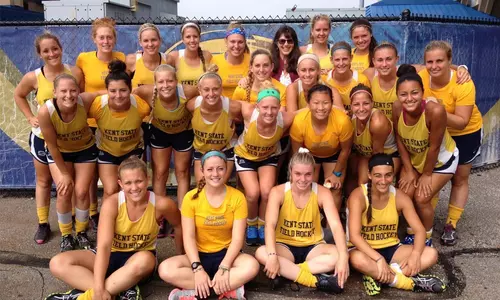
Kent State Field Hockey Aims to Shoot Out Parkinson's
9/30/2013 1:23:00 PM | Field Hockey
Click here to donate
Kent State field hockey is raising money for Parkinson's disease research on behalf of staff member Deborah Keith, who was diagnosed with the disease in 2010. The funds raised will go directly to Dr. Angela Ridgel's research program here at Kent State University.
The program will host a Shoot Out Parkinson's day for their game on Saturday, Oct. 12 against Central Michigan. More information on the game will become available at kentstatesports.com as the date nears.
On Behalf of Kent State's field hockey program:
Parkinson's is a disease that many people have heard about but not many people truly understand it. Parkinson's disease is a brain disorder that progresses slowly in most people. There is no known cure for Parkinson's, but there is a lot of research on how to slow down the progression of the disease.
As the Kent State field hockey team, we think it is important to raise awareness on this life changing disease. Some of our teammates have seen the noticeable repercussions of this disease in family members and friends.
We want to honor those people that live with this disease everyday. We want to honor their courage and bravery facing this disease every morning when they wake up. We are thankful that we have the opportunity to raise money for Dr. Angela Ridgel's Parkinson's research here at Kent State University. All together we can Shoot Out Parkinson's and continue to support the initiative to create a cure. We would appreciate your support for our cause.
From Kent State Learning Specialist and Life Coach Deborah Keith:
Thank you field hockey team for your support...
In October 2010, I was diagnosed with Parkinson's disease. Having been the Learning Specialist and Life Coach for Kent State's student athletes, as well as being a breast cancer survivor, I am no stranger to adversity; however, this diagnosis impacted me in ways I could not predict. It is as if I have become a "mental-athlete", facing each day with determination, appreciation, and perseverance. And each day, as I teach this perspective of courage, humor, and dignity to our student athletes, they, in return, teach it to me.
The fact that this very special team is willing to champion the cause of Parkinson's disease with their words and actions, means more than I can say. In so many ways each one of them has been an inspiration to me. Simply watching them train with such an amazing intensity motivates me to get out the door each day and exercise.
After all, exercise IS medicine to those with Parkinson's disease. Studies have proven that exercise can slow the progression of physical symptoms and may be neuron- protective, as well. This is why, to me, donating to a study that is focused on exercise for Parkinson's is crucial. In addition, the fact that a Kent State athletic team is helping in this fight inspires me to stand along side others in order to give a "face" to a progressive disease that needs all the "mental warriors" we can find.
To name just a few of some well-known faces of Parkinson's...
Linda Ronstadt, a gifted singer who lost her voice;?Dave Parker, seven-time major league All-Star formerly with Pittsburgh Pirates; Davis Phinney, Olympic medal winner and cycling great;?Michael J. Fox, actor and activist?Muhammed Ali, world-famous boxer;?Janet Reno, former Attorney General of the United States;?Billy Kennedy, current head men's Basketball Coach a Texas A&M University.
So, from the bottom of my heart, I thank you all, and, as I always say, "Have an unshakeable belief in yourself and your ability to face life head-on...and always keep sharing that belief with others!"
With gratefulness, Deborah Keith
From Assistant Professor, Exercise Science/Physiology, Angela L. Ridgel, PhD, CPT, HFS:
The primary goal of my current research program is to determine how different modes and intensities of exercise and motor training affects motor function and cognitive ability in individuals with Parkinson's disease (PD) and in older adults. This line of inquiry is important in order to develop additional methods of rehabilitation for neurological disorders and to understand brain and nervous system plasticity.
The Administration on Aging predicts that the US population of individuals over 65 will increase from 40 million in 2010 to 55 million in 2020. In anticipation of this trend, there is increased interest in lifestyle interventions that enhance cognitive ability in older adults and prevent age-related diseases such as Alzheimer's and PD.
Parkinson's disease is a progressive neurological disorder that affects 1 in 100 individuals over 60. The cardinal motor symptoms include resting tremors, slowness of movement and postural instability. There are also non-motor symptoms that accompany the disease such as cognitive impairment, mood disorders and sleep difficulties. In addition, individuals with PD show a six-fold increase in the probability of developing dementia compared to healthy older adults.
My research strives to provide important information to help address health issues of our increasing aged population.
From sophomore forward, Karleigh Carlin:
My grandfather has recently been diagnosed with Parkinson's disease. Even though I personally do not know much about it, it has affected my whole family and has brought us closer together for his sake.
Right now, we are trying to be there for him as much as possible. I hope that one day there will be a cure for this disease in hopes that nobody has to go what my grandfather is currently going through. All I can ask for right now to keep him in your prayers so that this process for him can be as painless as possible.
Kent State field hockey is raising money for Parkinson's disease research on behalf of staff member Deborah Keith, who was diagnosed with the disease in 2010. The funds raised will go directly to Dr. Angela Ridgel's research program here at Kent State University.
The program will host a Shoot Out Parkinson's day for their game on Saturday, Oct. 12 against Central Michigan. More information on the game will become available at kentstatesports.com as the date nears.
On Behalf of Kent State's field hockey program:
Parkinson's is a disease that many people have heard about but not many people truly understand it. Parkinson's disease is a brain disorder that progresses slowly in most people. There is no known cure for Parkinson's, but there is a lot of research on how to slow down the progression of the disease.
As the Kent State field hockey team, we think it is important to raise awareness on this life changing disease. Some of our teammates have seen the noticeable repercussions of this disease in family members and friends.
We want to honor those people that live with this disease everyday. We want to honor their courage and bravery facing this disease every morning when they wake up. We are thankful that we have the opportunity to raise money for Dr. Angela Ridgel's Parkinson's research here at Kent State University. All together we can Shoot Out Parkinson's and continue to support the initiative to create a cure. We would appreciate your support for our cause.
From Kent State Learning Specialist and Life Coach Deborah Keith:
Thank you field hockey team for your support...
In October 2010, I was diagnosed with Parkinson's disease. Having been the Learning Specialist and Life Coach for Kent State's student athletes, as well as being a breast cancer survivor, I am no stranger to adversity; however, this diagnosis impacted me in ways I could not predict. It is as if I have become a "mental-athlete", facing each day with determination, appreciation, and perseverance. And each day, as I teach this perspective of courage, humor, and dignity to our student athletes, they, in return, teach it to me.
The fact that this very special team is willing to champion the cause of Parkinson's disease with their words and actions, means more than I can say. In so many ways each one of them has been an inspiration to me. Simply watching them train with such an amazing intensity motivates me to get out the door each day and exercise.
After all, exercise IS medicine to those with Parkinson's disease. Studies have proven that exercise can slow the progression of physical symptoms and may be neuron- protective, as well. This is why, to me, donating to a study that is focused on exercise for Parkinson's is crucial. In addition, the fact that a Kent State athletic team is helping in this fight inspires me to stand along side others in order to give a "face" to a progressive disease that needs all the "mental warriors" we can find.
To name just a few of some well-known faces of Parkinson's...
Linda Ronstadt, a gifted singer who lost her voice;?Dave Parker, seven-time major league All-Star formerly with Pittsburgh Pirates; Davis Phinney, Olympic medal winner and cycling great;?Michael J. Fox, actor and activist?Muhammed Ali, world-famous boxer;?Janet Reno, former Attorney General of the United States;?Billy Kennedy, current head men's Basketball Coach a Texas A&M University.
So, from the bottom of my heart, I thank you all, and, as I always say, "Have an unshakeable belief in yourself and your ability to face life head-on...and always keep sharing that belief with others!"
With gratefulness, Deborah Keith
From Assistant Professor, Exercise Science/Physiology, Angela L. Ridgel, PhD, CPT, HFS:
The primary goal of my current research program is to determine how different modes and intensities of exercise and motor training affects motor function and cognitive ability in individuals with Parkinson's disease (PD) and in older adults. This line of inquiry is important in order to develop additional methods of rehabilitation for neurological disorders and to understand brain and nervous system plasticity.
The Administration on Aging predicts that the US population of individuals over 65 will increase from 40 million in 2010 to 55 million in 2020. In anticipation of this trend, there is increased interest in lifestyle interventions that enhance cognitive ability in older adults and prevent age-related diseases such as Alzheimer's and PD.
Parkinson's disease is a progressive neurological disorder that affects 1 in 100 individuals over 60. The cardinal motor symptoms include resting tremors, slowness of movement and postural instability. There are also non-motor symptoms that accompany the disease such as cognitive impairment, mood disorders and sleep difficulties. In addition, individuals with PD show a six-fold increase in the probability of developing dementia compared to healthy older adults.
My research strives to provide important information to help address health issues of our increasing aged population.
From sophomore forward, Karleigh Carlin:
My grandfather has recently been diagnosed with Parkinson's disease. Even though I personally do not know much about it, it has affected my whole family and has brought us closer together for his sake.
Right now, we are trying to be there for him as much as possible. I hope that one day there will be a cure for this disease in hopes that nobody has to go what my grandfather is currently going through. All I can ask for right now to keep him in your prayers so that this process for him can be as painless as possible.




Kent State Field Hockey signs Team Impact Athlete Arianna! ⚡️🏑 #kentstate #teamimpact #goflashes
Monday, October 06
Lauren Conroy puts it to the back of the net! ⚡️🏑 #kentstate #fieldhockey #collegesports #goflashes
Thursday, September 04
Emma Seger with a big deflection for the goal! ⚡️🏑🦅 #kentstate #fieldhockey #collegesports
Thursday, September 04
Maybritt Duwel gets a clean shot off the bounce for her second goal of the game! ⚡️🏑 #kentstate
Thursday, September 04